
Your medicine treats the cycle. Who holds the couple between cycles?
Conceive Within is a structured emotional-wellness programme for couples navigating fertility treatment — the between-cycles companion for everything IVF doesn't treat. Your clinic refers; couples enrol directly; your team carries nothing extra. This page gives you everything needed to evaluate the partnership.

Zero referral fees, ever. Fully aligned with medical-ethics norms on fee-splitting.
We never comment on protocols, medication, or clinical decisions. Your treatment plan stays yours.
We never suggest emotional work improves pregnancy odds. We support the person, not the prognosis.
The hardest part of treatment happens after the patient leaves your building
Research on IVF discontinuation consistently points to the same finding: couples most often stop treatment not because medicine has run out of options, but because the emotional burden becomes unbearable — the two-week wait, the negative result, the silence between cycles.
What your team sees
Couples who don't return after a failed cycle. Tearful calls your front desk isn't trained to hold. Consultation time absorbed by grief the consultation can't fix. Partners sitting in the waiting room with nowhere to put what they're feeling.
What a referral changes
The couple has a named, structured place to take the emotional weight — within 72 hours of a hard result. Your clinicians stay focused on medicine. And a couple who feels held between cycles is a couple more able to return for the next one, whatever they decide.
Structured support, keyed to your treatment milestones
This is not open-ended talk therapy and not a wellness app. It is a sequenced programme delivered personally, in three phases, with an in-cycle library that follows the couple through the moments your protocol creates.
Aftermath
Immediate stabilisation after a negative result or loss — including a 72-hours audio, permission-to-grieve work, sleep restoration, and dedicated material for the partner.
Restore
Rebuilding emotional capacity between cycles: regulating the body's stress response, restoring the couple's connection, and separating self-worth from test results.
Rewire
Deeper pattern work so each new cycle isn't carried with the accumulated weight of every previous one.
Seven guided pieces keyed to treatment milestones — injection days, retrieval, transfer, the two-week wait, test day — so support arrives at the exact moment the protocol makes it hardest to cope. Couples in active treatment use it alongside, never instead of, your care.
How couples enrol
Couples choose a tier and pay directly. Your clinic handles no money, no scheduling, no paperwork.
Individual programme — the full three-phase sequence, self-paced with guided material.
The couple's programme — both partners supported, including partner-specific material.
The highest-touch tier — direct one-to-one support through the full arc of treatment.
What we do — and what we will never do
A referral is a lending of your credibility. These boundaries are stated on every patient-facing page, and you are welcome to hold us to them.
Referral in three steps — nothing for your staff to manage
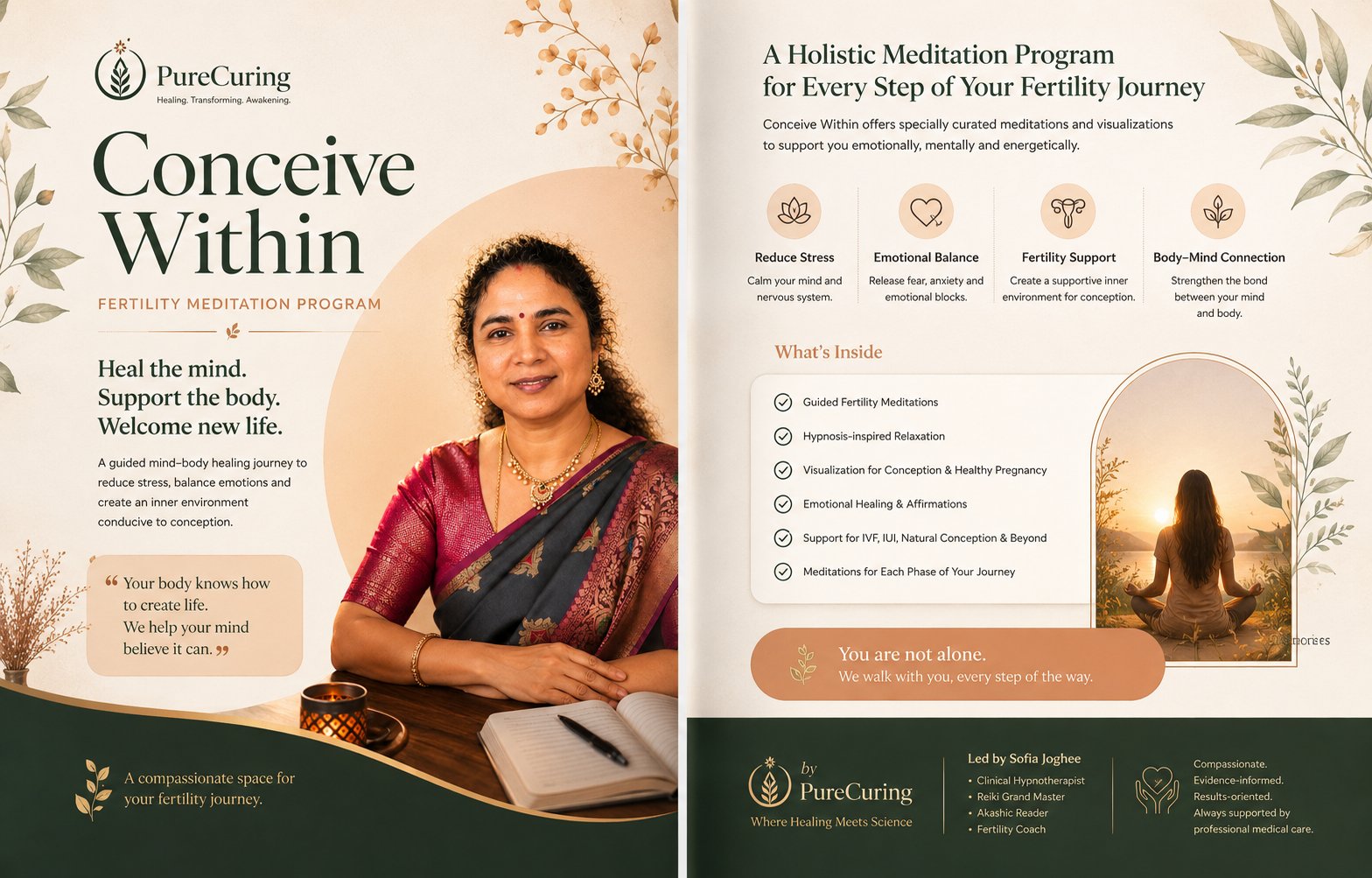
We supply A6 referral cards and a waiting-room brochure. A doctor, nurse, or counsellor hands the card at a natural moment — that is the entire clinical workload.
They contact us directly by phone or the card's link. Enrolment, payment, and scheduling all happen on our side.
During the pilot, your clinic receives a simple periodic summary: referrals received, enrolments, and anonymised feedback — never session content.
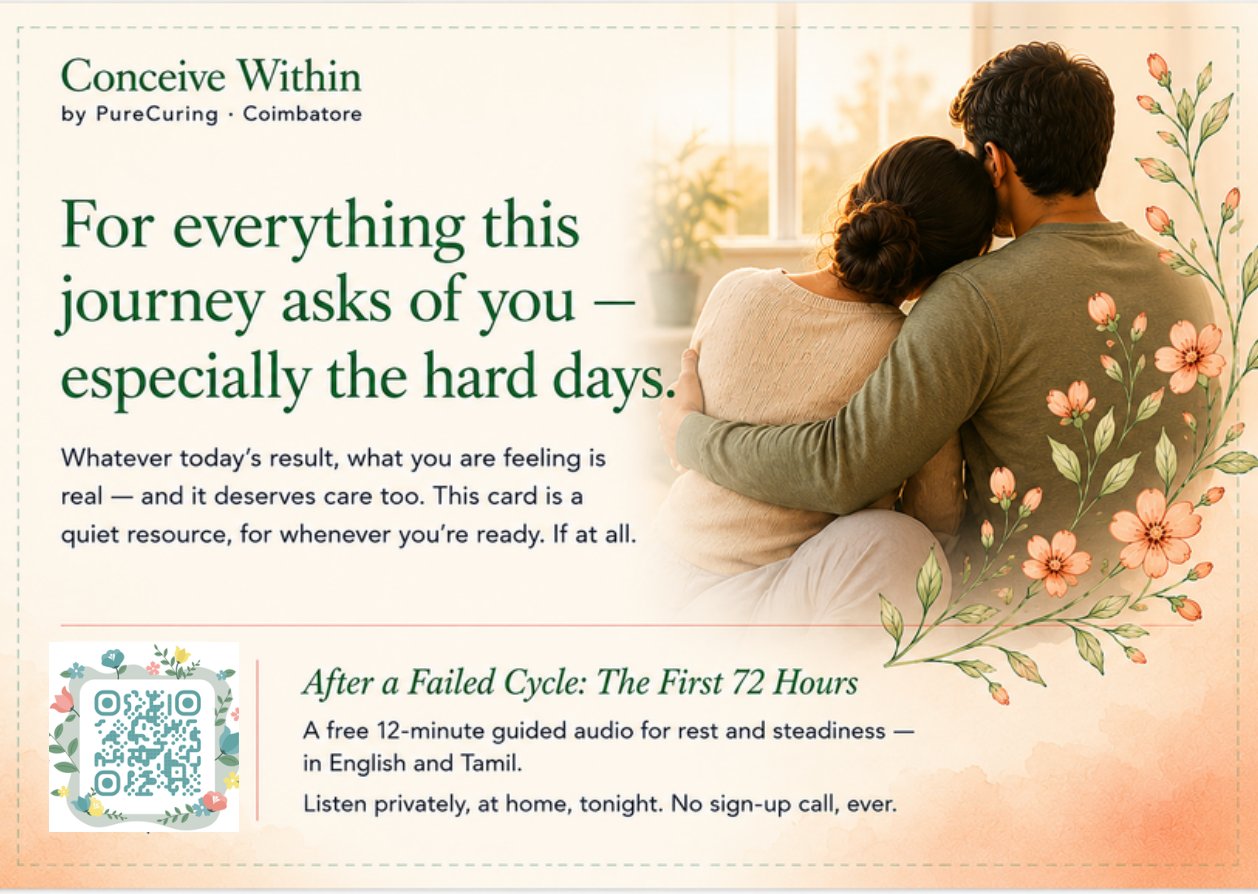
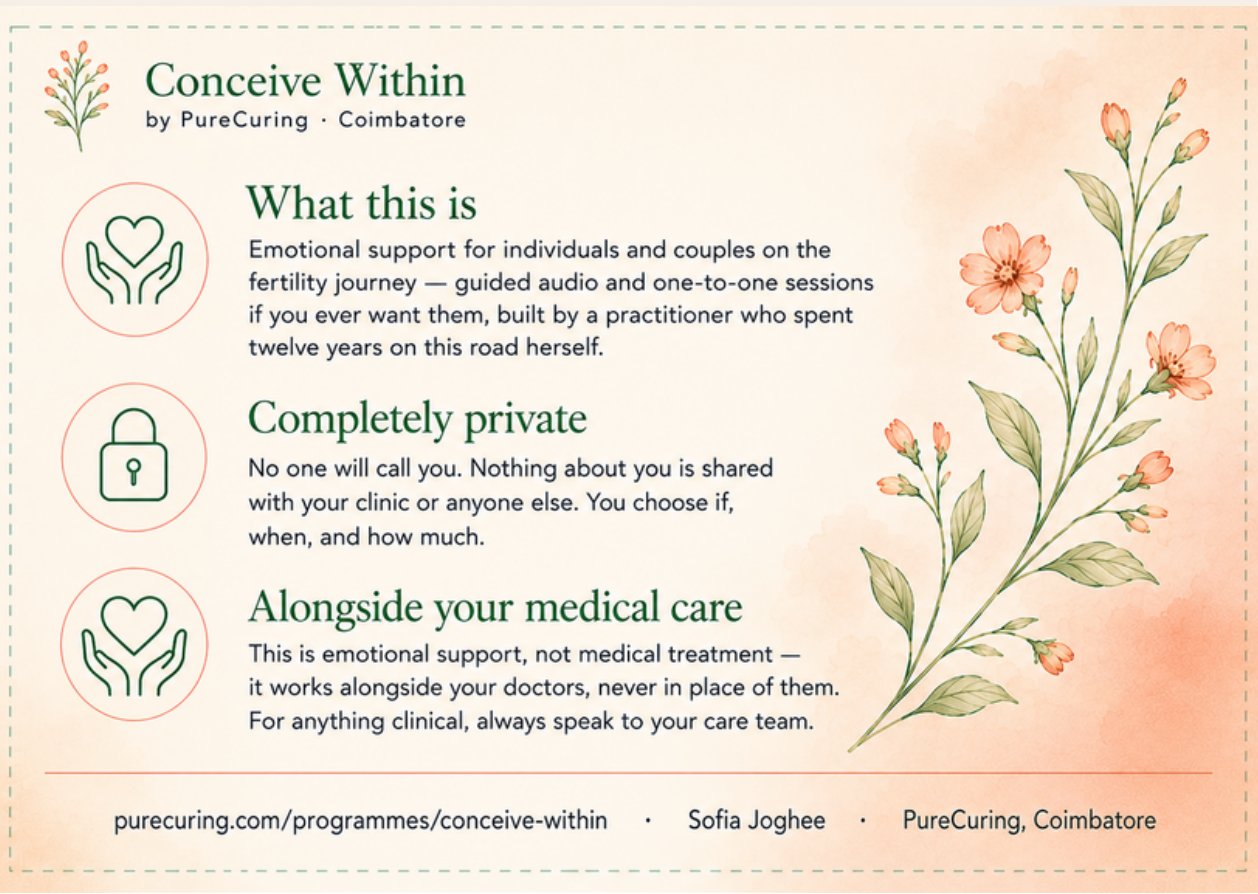
The three natural referral moments
| Moment | What the clinician says |
|---|---|
| After a negative result or loss | "The next few weeks are often the hardest part. This is a programme built for exactly this period — it's separate from us, and there's no obligation." |
| Between cycles | "Before we start the next cycle, some couples find structured emotional support helps them come back steadier." |
| Visible distress in consultation | "What you're feeling is more common than you'd believe. I can't give it the time it deserves here — this is someone who can." |
Sofia Joghee
Sofia is a mind-body practitioner, not a physician — and every piece of programme material says so plainly. Her work sits deliberately in the space clinical care cannot reach: the grief, fear, and relational strain that treatment creates but medicine cannot prescribe for.
Based in Coimbatore, working with couples in person and online, she built Conceive Within around one observation from practice: couples don't fail treatment emotionally on test day — they fail in the unheld weeks after it.
She is happy to meet your clinical team, walk through any programme material in full, and answer scope questions directly before any card reaches a patient's hand.

- Clinical hypnotherapy & counselling
- EFT & Matrix Reimprinting
- Inner-child & regression work
- Couple relationship healing
- PureCuring proprietary techniques
Start with a small, reversible pilot
No agreements, no exclusivity, no cost to the clinic. Just a clean test of whether your patients are better served with this option on the table.
- We supply materials — brochures for the waiting area and A6 referral cards for consulting rooms, in your preferred quantity.
- Your team refers at the three natural moments for a defined pilot window — a handful of couples is enough to evaluate.
- You receive a summary at the end of the window: referral-to-enrolment numbers and anonymised couple feedback.
- Then you decide — continue, adjust, or stop, with a single message. Materials come off the desk the same day.
Straight answers
Is this therapy? Does it replace psychological or psychiatric care?
No. It is structured emotional-wellness coaching and support. Anyone whose intake screening or sessions indicate clinical-level need is referred to licensed mental-health professionals — this is a mandatory, non-skippable step in our process.
Will this interfere with our treatment plan or advice?
Never. We do not discuss protocols, medication, or timing, and any clinical question a couple raises is redirected back to your team, verbatim: "That's a question for your doctor."
What does the clinic pay, or earn?
Nothing, in both directions. Couples pay us directly for their programme. Your clinic receives no fee and pays no fee — the referral stays clean, and defensibly so.
What happens to patient information?
Couples share their information with us directly and voluntarily when they choose to enrol. We never ask your clinic for patient data, and session content is never shared back — only anonymised, aggregate pilot feedback, with the couple's consent.
Do you claim this improves IVF success rates?
No — and we will not, in any material, ever. The honest claim is narrower and still valuable: couples who are emotionally supported are better able to withstand treatment, communicate with their clinicians, and make clear decisions about continuing.