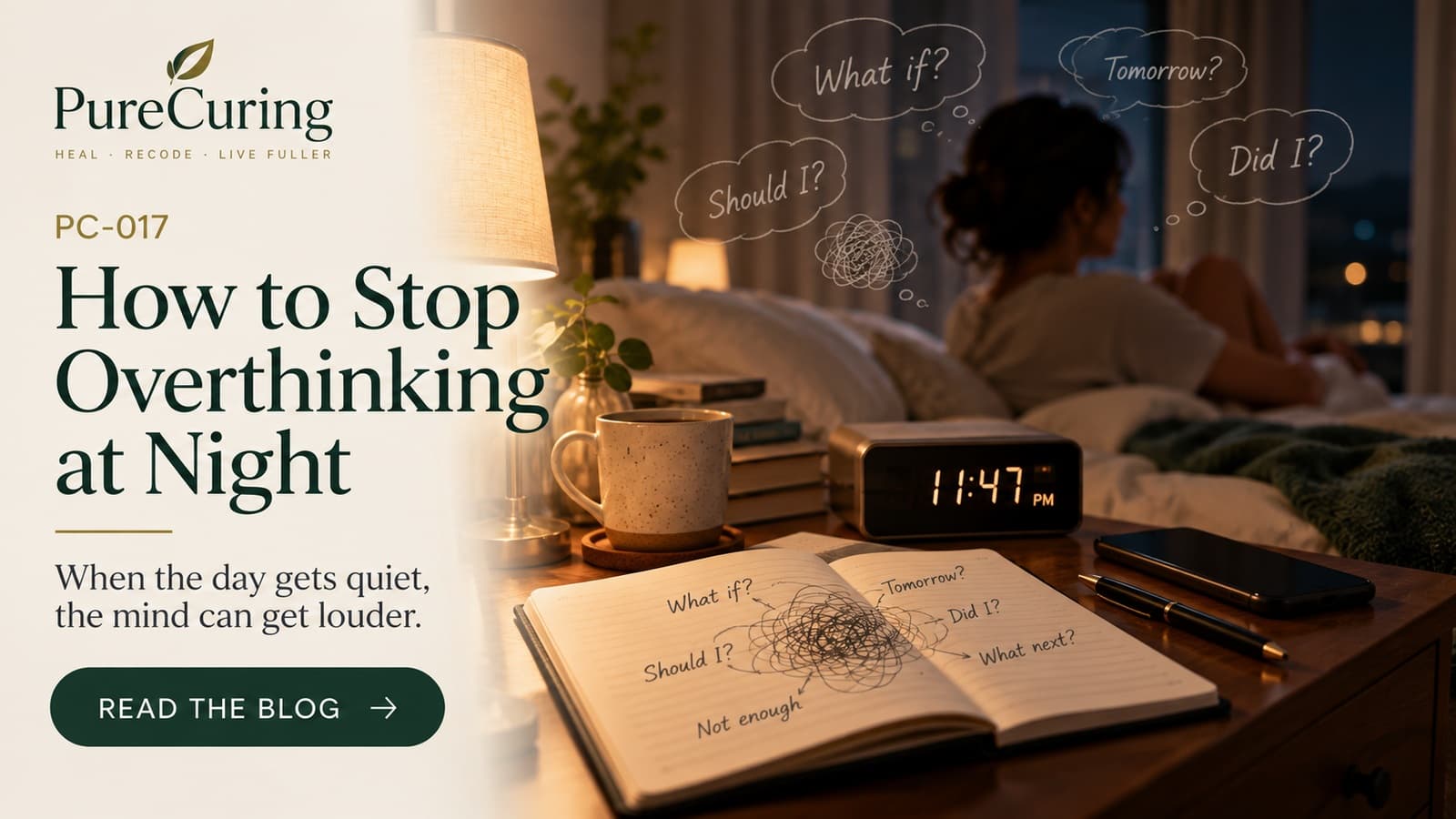
The day is finally over.
The messages have stopped. Work is finished. The house is quiet. There is nothing left that you urgently need to do.
And suddenly, your mind becomes very busy.
You remember the conversation from three days ago.
You think about tomorrow's meeting.
You replay something you said.
You wonder whether you made the right decision.
Then another thought appears:
“What if…?”
And just like that, sleep feels further away.
Nighttime overthinking can be especially frustrating because the quiet that should allow you to rest can create more space for repetitive thoughts.
The goal is not to force your mind to become completely empty.
A more useful goal is to understand why the mental loop becomes louder at night and learn how to stop feeding it.
Why Do I Overthink More at Night?
Nighttime changes the environment around you.
During the day, your attention is constantly being directed outward. Work, conversations, errands, notifications and responsibilities compete for your attention.
At night, many of those distractions disappear.
That can make thoughts that were pushed aside during the day much more noticeable.
You may suddenly have enough mental space to process:
- Something unresolved at work
- A difficult conversation
- A relationship concern
- A decision you have been postponing
- Something you regret
- A future possibility
- A fear you have not had time to think about
This does not necessarily mean that nighttime thoughts are more accurate.
They may simply be more noticeable because there is less competing stimulation.
The Difference Between Thinking and Overthinking
Thinking before bed is not automatically a problem.
You might reflect on your day, plan tomorrow or consider something important.
Overthinking becomes more frustrating when the thinking becomes repetitive without producing useful resolution.
For example:
Thinking:
“I need to prepare three points for tomorrow's meeting.”
You make a note and have a plan.
Overthinking:
“What if they disagree? What if I sound unprepared? Maybe I should change everything. What if they ask something I cannot answer? Maybe I should send another message tonight…”
The second sequence can keep generating new uncertainty without creating proportionate new information.
A useful question is:
“Am I solving something right now, or am I repeatedly trying to feel certain?”
Why Does the Mind Keep Returning to the Same Thought?
Sometimes a thought remains active because something feels unresolved.
You may be trying to:
- Find certainty
- Prevent a mistake
- Avoid regret
- Predict another person's reaction
- Prepare for a difficult outcome
- Make sure you have not missed something
- Regain a sense of control
The mind can keep analysing because it believes another round of thinking might finally produce the feeling you are looking for.
But certainty is not always available.
You can think about tomorrow's meeting for another hour without being able to know exactly what another person will say.
You can replay a conversation repeatedly without changing what has already happened.
You can analyse a decision from every angle without obtaining a guarantee that you will never regret it.
This is one reason overthinking can become circular.
The mind is searching for an answer to a question that may not have a completely certain answer.
Why Quiet Can Make Racing Thoughts Feel Louder
Imagine listening to a clock in a silent room.
During the day, you may barely notice it.
At night, every tick becomes obvious.
Thoughts can work in a similar way.
The thought itself may not be new.
Your awareness of it is simply stronger.
This is why a useful first step is not necessarily:
“How do I make my thoughts stop?”
Try:
“What happens when I give this thought my full attention?”
If you notice that every thought immediately becomes another question, you may be entering a mental loop.
For example:
Thought → analysis → doubt → more analysis → temporary reassurance → new doubt
Recognising the sequence can be more useful than fighting each individual thought.
What to Do When Your Mind Starts Racing at Night
You do not need a complicated routine.
Start by changing your relationship with the thought.
1. Name the loop
Instead of immediately following the thought, identify what is happening.
Try:
“I am overthinking this.”
Or:
“My mind is trying to solve this right now.”
This creates a small amount of distance between you and the thought.
You are observing the process rather than automatically entering it.
2. Ask whether there is anything you can actually do tonight
This is one of the most useful questions for nighttime thinking.
If there is an action you can take now, make it very small.
For example:
- Write tomorrow's task on paper.
- Put an appointment in your calendar.
- Make a short note of what you need to remember.
- Decide when you will revisit the issue tomorrow.
Then stop.
If there is nothing useful you can do until tomorrow, tell yourself:
“This matters, but I do not have to solve it tonight.”
That is not avoidance.
It is recognising that timing matters.
3. Write the thought down
A thought can feel more urgent when you are afraid you will forget it.
Keep a notebook beside the bed and write down the issue in one or two sentences.
For example:
“Ask about the project timeline tomorrow.”
Or:
“I am worried about how the conversation went. Revisit this tomorrow afternoon.”
The purpose is not to solve the problem on paper at midnight.
It is to give your mind evidence that the thought has been captured.
4. Separate facts from predictions
Nighttime overthinking often mixes what you know with what you fear might happen.
Write two columns:
What I know
and
What I am predicting
For example:
What I know: “My manager asked to speak with me tomorrow.”
What I am predicting: “I must have done something wrong.”
The second statement may feel convincing, but it is still a prediction.
This simple distinction can reduce the tendency to treat every possibility as a fact.
5. Give tomorrow's thinking a container
If your mind keeps saying:
“But I need to figure this out now.”
Give it a specific time.
For example:
“I will spend 20 minutes on this tomorrow at 10:00.”
Then return your attention to the present.
This can be particularly useful for problems that genuinely require thought but do not require immediate action.
What If You Cannot Stop Thinking About Something That Happened?
Nighttime rumination often focuses on the past.
You replay the conversation.
You analyse your response.
You wonder whether you should have said something differently.
You imagine how the other person interpreted it.
Try changing the question.
Instead of:
“Why did I do that?”
ask:
“Is there something I can learn or repair?”
If there is, identify the next action.
If there is not, you may be trying to change something that has already happened through repeated mental review.
Reflection can help you learn.
Replaying the same scene without a new purpose can keep you emotionally engaged with it.
What If the Thoughts Are About Tomorrow?
Future-focused thinking often takes the form of “what if” questions.
What if I fail?
What if they judge me?
What if I forget something?
What if I cannot handle it?
What if everything goes wrong?
Rather than answering every “what if,” ask:
“What would I do if this actually happened?”
This shifts the mind from prediction to preparation.
You may discover that you already have a reasonable response.
And if there is genuinely nothing you can do tonight, you have another useful answer:
“I will deal with this when there is something I can actually do.”
Do Not Turn Sleep Into Another Performance Task
This is an important distinction.
If you lie in bed thinking:
“I have to fall asleep now.”
you may add another layer of pressure.
Then you start checking the clock.
Calculating how many hours are left.
Worrying about how tired you will be tomorrow.
Trying harder to sleep.
And becoming increasingly alert.
For people with persistent insomnia, evidence-based treatment commonly includes Cognitive Behavioral Therapy for Insomnia (CBT-I), which can address sleep-related thoughts and behaviours alongside techniques such as stimulus control and sleep scheduling. The American Academy of Sleep Medicine describes CBT-I as a first-line behavioral treatment for chronic insomnia.
This is different from simply trying to “think positively” before bed.
If sleep difficulty is persistent and affecting daytime functioning, it is worth discussing it with an appropriately qualified healthcare professional.
A Simple Nighttime Reset
When you notice the loop beginning, try this sequence:
Notice → Write → Decide → Release
Notice
“My mind is looping.”
Write
Put the main concern on paper.
Decide
Ask:
“Is there something I need to do tonight?”
If yes, take the smallest useful action.
If no, schedule when you will revisit it.
Release
Return your attention to something quiet and non-demanding rather than continuing the analysis.
The aim is not to guarantee sleep.
It is to stop turning one thought into twenty more.
Why the Same Thoughts May Keep Returning
If nighttime overthinking happens repeatedly, there may be a deeper pattern underneath the immediate thought.
Perhaps uncertainty is particularly difficult for you.
Perhaps you learned to prevent mistakes by thinking through every possibility.
Perhaps approval matters so much that you repeatedly analyse how other people may perceive you.
Perhaps staying mentally busy feels safer than sitting with an uncomfortable emotion.
Perhaps your mind has become accustomed to solving emotional discomfort through analysis.
The surface thought may change:
“What will they think?”
“What if I fail?”
“Did I make the right choice?”
“What if something goes wrong?”
But the underlying need may remain similar.
It might be certainty.
Control.
Safety.
Approval.
Protection from regret.
That is where overthinking can become more than a nighttime habit.
It can become part of a recurring emotional pattern.
The Deeper Question Behind Nighttime Overthinking
The next time you are lying awake with the same thought, try asking:
“What am I hoping this thinking will give me?”
Not:
“What is the answer?”
But:
“What am I trying to feel?”
Maybe you want to feel certain.
Maybe you want to feel safe.
Maybe you want reassurance that you have not made a mistake.
Maybe you want to feel prepared for every possible outcome.
There is nothing wrong with wanting those things.
The important insight is that thinking may not always be the way to obtain them.
Sometimes the next step is not more analysis.
It is learning to tolerate a small amount of uncertainty without immediately trying to eliminate it.
A Small Exercise for Tonight
If your mind starts looping tonight, take a piece of paper and write:
The thought: What keeps coming back?
The emotion: What do I feel underneath it?
The fear: What am I afraid might happen?
The need: What am I hoping to get from solving this?
The next action: Is there anything useful I can do now?
Then stop.
You do not need to solve your whole life at bedtime.
You only need to recognise what is happening.
That recognition can be the beginning of changing the pattern.
From Overthinking to Pattern Awareness
Nighttime overthinking can feel like a problem with your thoughts.
Sometimes, however, the more useful place to look is the sequence underneath them:
Trigger → emotion → thought → mental loop → temporary relief → more uncertainty
Once you can see the sequence, you have more information about what keeps the loop alive.
And instead of asking:
“Why can't I control my mind?”
you can begin asking:
“What pattern is my mind repeating, and what is it trying to protect me from?”
That is a very different starting point.
Frequently Asked Questions About Overthinking at Night
Why do I overthink at night?
Nighttime removes many of the distractions that occupy attention during the day, so unresolved concerns and repetitive thoughts can become more noticeable. The quiet itself is not necessarily causing the thoughts; it may simply make them easier to notice.
How do I stop overthinking at night?
Start by identifying whether there is a useful action you can take now. If there is, make a short plan. If there is not, write the concern down and schedule a time to revisit it. This can help separate problem-solving from repetitive analysis.
Why do I get racing thoughts when I try to sleep?
Racing thoughts can have many possible contributors, including stress, worry, unresolved concerns and learned habits around bedtime. Persistent sleep difficulties should be discussed with an appropriately qualified healthcare professional rather than assumed to have one cause.
Should I write my thoughts down before bed?
Writing down concerns or tomorrow's tasks can be useful for externalising what you are holding in mind. The purpose is not to solve everything at bedtime but to give yourself a place to return to the issue later.
Is nighttime overthinking the same as insomnia?
Not necessarily. Overthinking can occur without insomnia, and insomnia involves persistent difficulty initiating or maintaining sleep or obtaining restorative sleep despite adequate opportunity, with associated daytime impairment. Persistent sleep problems deserve proper assessment.
What if I keep having the same thought every night?
Repeated thoughts may be part of a recurring pattern involving uncertainty, worry, reassurance-seeking, perfectionism or emotional avoidance. Rather than fighting each thought individually, look for what triggers the loop and what the thinking appears to be trying to accomplish.
Explore Your Own Pattern
If you notice that the same mental loops keep appearing—not only at night, but around decisions, relationships, work or uncertainty—it may be useful to look beyond the individual thought and understand the recurring pattern.
The RECODE Pattern Check is a self-reflection tool designed to help you notice patterns in the way you respond to situations.
Start with the RECODE Pattern Check and explore what may be repeating beneath the surface.
The RECODE Pattern Check is a self-reflection tool and is not a clinical diagnosis or a substitute for professional medical or mental-health care.
Written by Sofia Joghee
Sofia Joghee is the creator of the RECODE Method™, a six-phase framework for transforming recurring emotional and subconscious patterns.