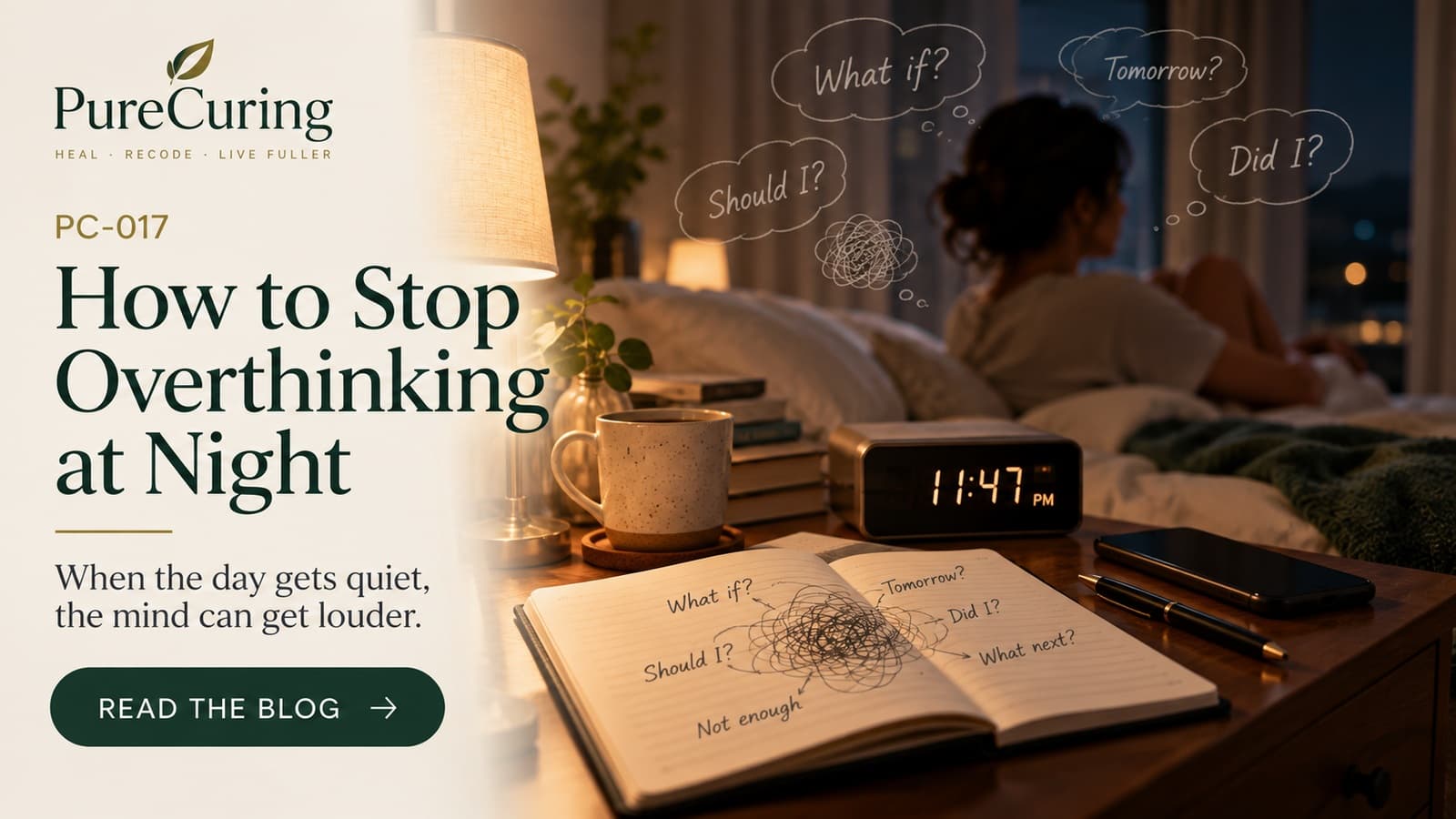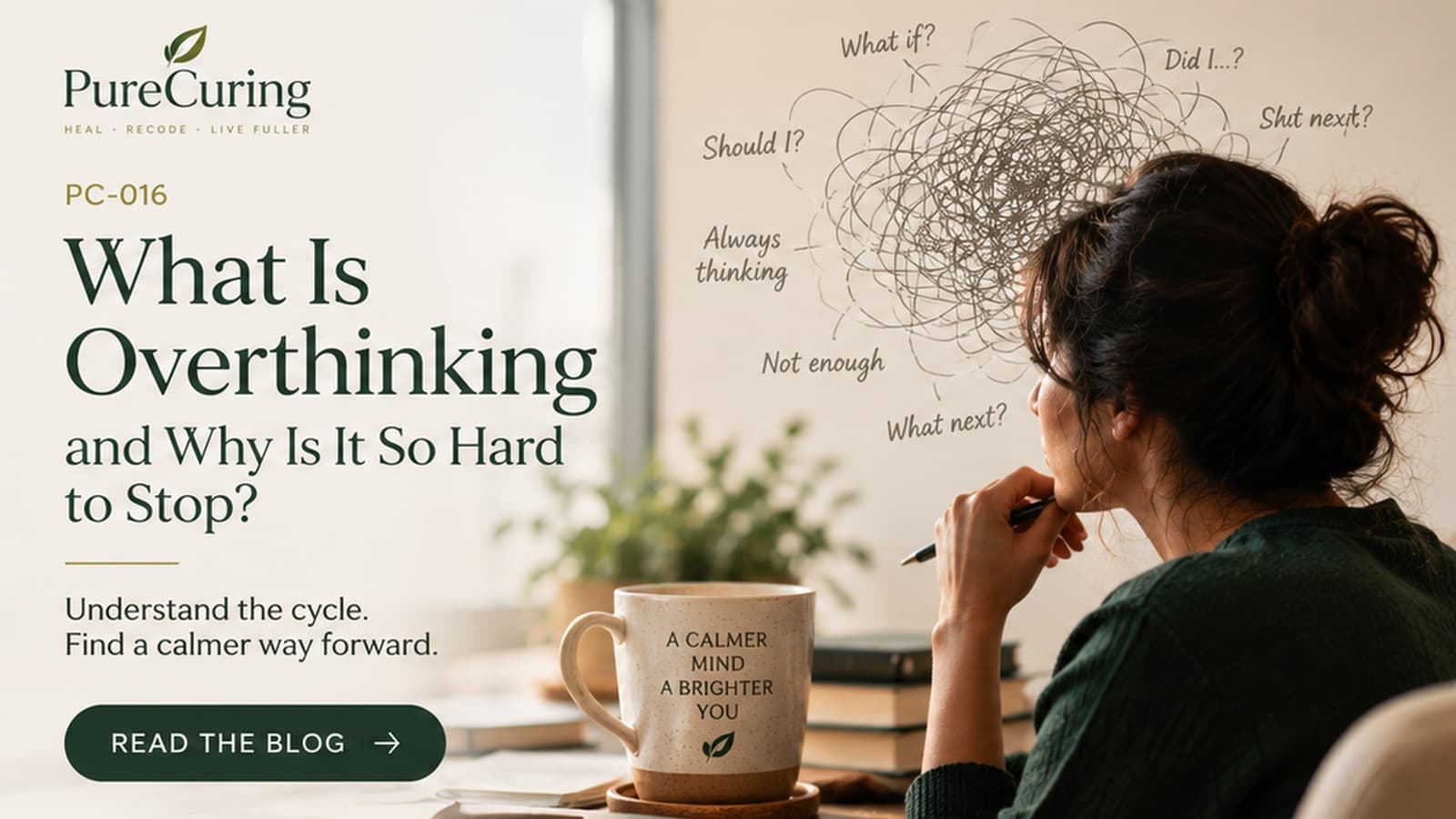
You make the decision.
Then you reconsider it.
You replay the conversation.
You imagine what could happen next.
You think of another possibility.
Then another.
And eventually, instead of feeling clearer, you feel more uncertain than when you started.
That is one of the strange things about overthinking: it can feel like you are doing something productive while actually remaining stuck in the same mental loop.
You may tell yourself:
“I just need to think this through properly.”
But how do you know when thinking has stopped helping and started repeating itself?
What Is Overthinking?
Overthinking is a common way of describing prolonged, repetitive thinking that does not lead to useful resolution.
It can involve repeatedly analysing:
- A decision you have already considered
- Something someone said
- Something you said yourself
- A mistake from the past
- A possible future problem
- What another person might think of you
- Whether you made the “right” choice
- What might happen if you choose differently
Overthinking is not simply thinking a lot.
Deep thinking can be useful. Planning can be useful. Reflection can be useful.
The difference is often what happens at the end.
Useful thinking tends to move you toward understanding, a decision or an action. Overthinking often keeps generating more questions without creating meaningful movement.
Researchers often study related processes under the broader concept of repetitive negative thinking (RNT). This includes patterns such as worry about the future and rumination about the past. Recent research describes these processes as repetitive, difficult-to-control forms of thinking that can overlap across different emotional difficulties.
Why Is Overthinking So Hard to Stop?
The obvious question is:
“If I know I am overthinking, why can't I just stop?”
Because overthinking may be doing something for you.
Not necessarily something helpful in the long term, but something that feels useful in the moment.
1. Your mind is looking for certainty
Many situations do not come with complete certainty.
You may have to choose without knowing exactly what will happen.
You may have to send the message without knowing how it will be received.
You may have to make a career decision without knowing whether it will work out.
You may have to enter a relationship without knowing how it will develop.
The mind can respond to uncertainty by searching for more information.
That makes sense—up to a point.
But if you keep analysing because you believe one more thought will finally remove all uncertainty, the process can become circular.
“If I think about this enough, I will feel completely certain.”
That expectation can keep the loop going.
2. Thinking can create a temporary sense of control
When something matters to you, uncertainty can feel uncomfortable.
Thinking gives you something to do.
You can compare options.
Predict outcomes.
Review evidence.
Imagine conversations.
Prepare for problems.
For a short time, this can make you feel more prepared.
But preparation and control are not the same thing.
Sometimes the mind continues analysing because analysis feels safer than acting without guarantees.
3. You may be trying to prevent a painful outcome
Overthinking often contains questions such as:
- What if I make the wrong choice?
- What if they are upset with me?
- What if I fail?
- What if I regret this?
- What if I missed something?
- What if something goes wrong?
At first glance, these questions seem protective.
Your mind may be trying to keep you from making a mistake.
But if every possible negative outcome has to be mentally eliminated before you act, action becomes almost impossible.
The goal quietly changes from making a good decision to finding a decision that carries no risk.
That decision may not exist.
Overthinking vs. Problem-Solving
This distinction can be surprisingly useful.
Imagine you need to decide whether to accept a new job.
Problem-solving might look like:
- What are the responsibilities?
- What is the compensation?
- What are the working conditions?
- What matters most to me?
- What information am I still missing?
- By when do I need to decide?
You gather relevant information, compare it with your priorities and make the best decision you can.
Overthinking might look like:
- What if I regret leaving?
- What if the new company is worse?
- What if people think I made a bad decision?
- What if I stay and later regret not leaving?
- What if I am missing something?
- What if I choose wrong?
- Maybe I should research one more review.
- Maybe I should ask one more person.
Then the same questions return tomorrow.
The issue is not that the questions are irrational.
The issue is that the thinking is no longer producing proportionate new information.
A useful question is:
“Am I learning something new, or am I revisiting the same uncertainty?”
What Does Overthinking Look Like in Everyday Life?
Overthinking does not always feel like obvious anxiety.
It can show up quietly.
You might:
- Re-read a message several times before sending it
- Replay a conversation long after it happened
- Search for reassurance from multiple people
- Keep researching after you already have enough information
- Delay decisions because you want complete certainty
- Imagine dozens of possible outcomes
- Constantly question whether you handled something correctly
- Find yourself mentally rehearsing conversations that may never happen
- Struggle to switch your attention away from one unresolved issue
Sometimes the biggest clue is not the amount of thinking.
It is repetition without resolution.
Why Do We Replay the Past?
One form of repetitive thinking is often called rumination.
Rumination tends to focus on something that has already happened:
“Why did I say that?”
“Why didn't I notice earlier?”
“What if I had handled it differently?”
Reflection can help you learn from an experience.
But rumination can keep returning to the same event without producing a useful next step.
The difference is subtle.
Reflection asks, “What can I understand or learn from this?”
Rumination keeps asking, “Why did this happen?” without reaching a point of resolution.
Research increasingly considers rumination and worry as related forms of repetitive negative thinking rather than completely separate processes.
Why Do We Worry About the Future?
Another form of repetitive thinking is worry.
Worry tends to move forward in time:
“What if something goes wrong?”
“What if I cannot handle it?”
“What if they reject me?”
“What if this decision ruins everything?”
The future is inherently uncertain.
That makes it especially easy for the mind to generate an endless number of possibilities.
One concern leads to another:
What if this happens? → Then what? → But what if that happens? → What would I do then?
Eventually, you may have mentally travelled through dozens of scenarios without becoming more prepared for the actual situation in front of you.
When Does Overthinking Become a Pattern?
A single period of intense thinking does not necessarily mean you have a recurring pattern.
Life sometimes requires serious reflection.
The more useful question is whether the same sequence appears repeatedly.
For example:
Uncertainty → discomfort → more analysis → temporary reassurance → new doubt → more analysis
Or:
Mistake → self-criticism → replaying the event → imagined consequences → more self-criticism
Or:
Decision → fear of getting it wrong → research → temporary confidence → another doubt → delayed decision
If you recognise one of these cycles, you may be looking at more than a single episode of overthinking.
You may be seeing a mental and emotional pattern.
Why Awareness Alone May Not Stop Overthinking
This is where many people become frustrated.
You may already know:
“I overthink everything.”
You may even know exactly when it happens.
And yet the next difficult decision arrives, and the loop starts again.
Awareness is important.
But knowing that a pattern exists does not automatically change the emotional response that activates it.
If uncertainty repeatedly triggers fear, for example, your mind may continue searching for certainty even after you consciously recognise what is happening.
That does not mean you are incapable of change.
It means the pattern may need to be understood at more than the level of the thought itself.
Instead of asking only:
“How do I stop thinking?”
it can be useful to ask:
“What am I trying to achieve by thinking about this again?”
Perhaps you are trying to feel certain.
Perhaps you are trying to avoid regret.
Perhaps you are trying to prevent rejection.
Perhaps you are trying to regain control.
Perhaps you are trying to make sure you never make another mistake.
The answer can reveal what is underneath the loop.
What Can You Do When You Notice Yourself Overthinking?
You do not have to force your mind to become completely silent.
Start by interrupting the cycle with a more useful question.
Ask: Is there a decision to make?
If yes, identify the next concrete action.
If no, ask whether continuing to analyse is actually helping.
Ask: What information am I missing?
Be specific.
If there is genuinely missing information, gather it.
If you already have enough information, recognise that you may be seeking certainty rather than information.
Ask: Has anything changed since the last time I thought about this?
If the answer is no, repeating the same analysis may not produce a different conclusion.
Ask: What am I afraid will happen?
This can move the conversation from the surface thought to the emotional layer underneath it.
Give the thinking a boundary
You might decide:
“I will think about this for 20 minutes, write down what I know, and then choose my next step.”
The aim is not perfect certainty.
It is enough clarity to move forward.
The Deeper Pattern Behind Overthinking
Sometimes the real issue is not the decision.
It is what the decision represents.
For one person, making a mistake may feel threatening because mistakes have historically been met with criticism.
For another, choosing independently may feel uncomfortable because approval has always been important.
For someone else, uncertainty may trigger a strong need for control.
This is why two people can face the same decision and experience completely different levels of mental looping.
The surface behaviour is the same:
They overthink.
The underlying pattern may be different.
That distinction matters.
Rather than asking:
“Why am I such an overthinker?”
you might ask:
“What does my mind believe it needs to protect me from?”
That question can open a different kind of understanding.
From Overthinking to Pattern Awareness
The next time you notice yourself entering the loop, try writing down four things:
1. Trigger What happened immediately before the thinking started?
2. Thought What question or possibility keeps returning?
3. Emotion What do you feel underneath the thinking—fear, guilt, uncertainty, embarrassment, pressure or something else?
4. Need What are you hoping the thinking will give you—certainty, control, safety, reassurance, approval or protection?
You do not need to diagnose yourself.
You are simply observing the sequence.
That shift—from “Why can't I stop thinking?” to “What pattern is operating here?”—can make the experience easier to understand.
What Current Research Tells Us
Research on repetitive negative thinking has increasingly examined worry and rumination as overlapping processes that can occur across different forms of psychological distress. A 2024 review proposed a broader model of repetitive negative thinking, while a 2025 transdiagnostic meta-analysis of 55 studies involving 4,970 participants found that CBT interventions produced a moderate reduction in repetitive negative thinking compared with control conditions. The researchers also noted substantial variation between studies, so these findings should not be interpreted as a guarantee for any individual.
The practical takeaway is not that every episode of overthinking requires treatment.
It is that repetitive thinking is a well-studied process, and there are evidence-based psychological approaches that specifically address it.
If overthinking is persistent, severely distressing, disrupting sleep or functioning, or occurring alongside significant anxiety or low mood, consider speaking with an appropriately qualified mental-health professional.
Frequently Asked Questions About Overthinking
What is overthinking?
Overthinking is a common term for repetitive, prolonged thinking that does not lead to useful resolution. It can involve repeatedly analysing decisions, conversations, mistakes or possible future outcomes.
Is overthinking the same as anxiety?
Not necessarily. Overthinking can occur without a mental-health disorder, while anxiety can involve many experiences beyond repetitive thinking. Persistent worry and rumination are, however, closely studied in relation to anxiety and other forms of psychological distress.
Why do I overthink everything?
There is no single explanation. Overthinking may become a way of seeking certainty, control, reassurance or protection from unwanted outcomes. The pattern can differ from person to person.
How do I stop overthinking?
Start by identifying whether there is a real problem to solve, what information is genuinely missing and what emotion may be driving the repeated analysis. Setting a clear decision point can also help interrupt endless reconsideration.
Is overthinking a sign of intelligence?
Overthinking should not be treated as a reliable measure of intelligence. Careful reasoning and repetitive thinking are different processes. Someone can think deeply without becoming trapped in an unproductive loop.
Can overthinking become a recurring emotional pattern?
Yes, repeated overthinking can become part of a broader pattern in which a particular trigger consistently produces uncertainty, emotional discomfort and repeated mental analysis. Understanding the sequence can be a useful starting point.
Explore Your Own Pattern
If you notice that the same mental loops keep appearing around decisions, relationships, work or everyday situations, the first step may be to understand the pattern rather than simply telling yourself to “stop overthinking.”
The RECODE Pattern Check is a self-reflection tool designed to help you notice recurring patterns in the way you respond to situations.
Start with the RECODE Pattern Check to explore what may be showing up repeatedly in your life.
The RECODE Pattern Check is a self-reflection tool and is not a clinical diagnosis or a substitute for professional medical or mental-health care.
Written by Sofia Joghee
Sofia Joghee is the creator of the RECODE Method™, a six-phase framework for transforming recurring emotional and subconscious patterns.